Research Use Only | Third-Party Tested | Secure Checkout | Fast Shipping
GHK-Cu Copper Peptide: Research Overview, Structure, and Biological Signaling Pathways
Learn about GHK-Cu, a copper peptide studied in research for its role in cellular signaling, gene expression regulation, and tissue organization pathways.
PEPTIDE RESEARCH GUIDES
3/5/20264 min read

GHK-Cu Copper Peptide: Research Overview, Structure, and Biological Signaling Mechanisms
GHK-Cu is a naturally occurring copper-binding peptide that has attracted significant interest in scientific research due to its role in cellular signaling and tissue maintenance pathways. This peptide is composed of three amino acids—glycine, histidine, and lysine—that form a complex with copper ions, creating what is commonly referred to as a copper peptide complex.
Researchers study GHK-Cu because peptides serve as signaling molecules that help regulate communication between cells. In laboratory research, GHK-Cu has been examined for its interactions with biological pathways involved in cellular repair, gene expression, and tissue organization.
Because of these biological interactions, GHK-Cu continues to be an important subject of investigation in fields such as molecular biology, regenerative research, and biotechnology.
What Is GHK-Cu?
GHK-Cu stands for glycyl-L-histidyl-L-lysine copper complex. It is a small peptide naturally found in human plasma, saliva, and urine. When the GHK peptide binds with a copper ion, it forms the biologically active complex known as GHK-Cu.
Copper is an essential trace mineral involved in numerous biological processes, including enzyme function and cellular signaling. When bound to peptides like GHK, copper can participate in molecular interactions that influence cellular communication.
In research settings, GHK-Cu is studied for its interactions with biological pathways related to:
cellular repair mechanisms
tissue remodeling processes
gene expression signaling
extracellular matrix regulation
cellular communication pathways
Because this peptide occurs naturally in biological systems, it has become an important focus of scientific investigation.
Structure and Amino Acid Composition of GHK-Cu
GHK-Cu is considered a tripeptide, meaning it consists of three amino acids:
Glycine
Histidine
Lysine
These amino acids form the peptide sequence GHK, which can bind to copper ions to create the GHK-Cu complex.
The copper ion plays an important role in the biological activity of the peptide because it allows the molecule to interact with certain biochemical pathways involved in cellular signaling.
Peptides like GHK-Cu are relatively small compared with proteins, which makes them easier to study in laboratory environments. Their compact structure allows researchers to analyze how they interact with cellular receptors and signaling networks.
Biological Role of Copper Peptides
Copper peptides such as GHK-Cu are believed to play a role in regulating biological signaling systems related to tissue maintenance and cellular communication.
Copper itself is an essential trace element required for the function of many enzymes and proteins within biological systems. When copper binds with peptides, it can influence molecular processes involved in cellular activity.
Scientific research involving copper peptides often focuses on pathways associated with:
cellular regeneration signaling
extracellular matrix regulation
tissue organization mechanisms
gene expression modulation
antioxidant enzyme activity
Understanding how copper peptides interact with these systems may provide insight into how biological processes are regulated at the molecular level.
Biological Pathways Studied in GHK-Cu Research
Researchers studying GHK-Cu often investigate several important biological pathways.
Gene Expression Regulation
One area of scientific interest involves how GHK-Cu interacts with gene expression pathways. Some research models examine how peptides influence the activation or suppression of specific genes involved in cellular function.
Gene expression plays a critical role in determining how cells respond to signals and environmental changes.
Extracellular Matrix Signaling
The extracellular matrix (ECM) is a structural network surrounding cells that provides support and regulates communication between tissues.
Studies involving copper peptides often examine how these molecules interact with signaling pathways that influence extracellular matrix organization.
Cellular Communication and Repair Mechanisms
Peptides are frequently studied because they function as signaling messengers between cells. Researchers explore how peptides like GHK-Cu may influence pathways involved in cellular communication and biological repair processes.
Understanding these signaling networks can help scientists better understand how tissues maintain structure and function.
Antioxidant and Cellular Defense Pathways
Copper peptides have also been examined in research models related to antioxidant activity and cellular defense mechanisms.
Antioxidant systems help protect cells from oxidative stress, which can influence cellular stability and molecular signaling.
Why Scientists Study GHK-Cu
GHK-Cu is widely studied because peptides offer powerful tools for investigating cellular signaling pathways and biological communication systems.
By studying GHK-Cu, researchers can explore how small peptide molecules interact with complex biological networks.
Scientific interest in this peptide has contributed to research in areas such as:
molecular biology
regenerative research
biotechnology development
cellular signaling science
These investigations help scientists understand how peptide signaling contributes to the regulation of biological processes.
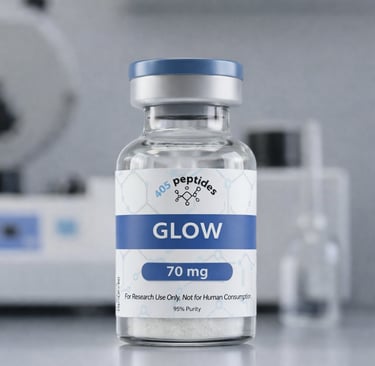
GHK-Cu is a key ingredient in Peptide GLOW, available for laboratory research through 405 Peptides.
Synthetic Peptides and Laboratory Research
Although GHK occurs naturally in the body, researchers often produce synthetic versions of the peptide for laboratory experiments.
Synthetic peptides are created using solid-phase peptide synthesis, a technique that allows scientists to construct specific amino acid sequences with high precision.
This method enables researchers to study peptides under controlled conditions and analyze how they interact with biological systems.
Synthetic peptide research is widely used in biotechnology and molecular science to investigate how signaling molecules regulate cellular behavior.
The Growing Interest in Copper Peptide Research
Interest in copper peptides has expanded as scientists explore the complex molecular networks that regulate tissue organization and cellular signaling.
Advances in biotechnology and peptide synthesis technologies have made it possible to examine how copper peptides interact with biological pathways at the molecular level.
Research involving peptides such as GHK-Cu continues to expand across disciplines including:
molecular biology
regenerative science
dermatological research
biotechnology development
As scientific understanding grows, copper peptides remain an important area of investigation for researchers studying cellular signaling systems.
Frequently Asked Questions
What is GHK-Cu?
GHK-Cu is a naturally occurring copper peptide composed of three amino acids—glycine, histidine, and lysine—that bind to a copper ion to form a biologically active complex.
Why do scientists study copper peptides?
Researchers study copper peptides because they interact with biological signaling pathways related to cellular communication, gene expression, and tissue organization.
What does the GHK sequence represent?
GHK refers to the amino acid sequence glycine-histidine-lysine, which forms the peptide structure that binds to copper.
How are synthetic copper peptides produced?
Synthetic copper peptides are produced through laboratory methods such as solid-phase peptide synthesis, which allows scientists to construct precise amino acid sequences for research.
Research Disclaimer
All compounds available through 405peptides are intended strictly for laboratory and research purposes only and are not intended for human or veterinary use.
Browse our research-grade peptides at 405Peptides.com.

Contact
Get in touch
© 2025 Copyright. 405research. All rights reserved.