Research Use Only | Third-Party Tested | Secure Checkout | Fast Shipping
Peptides in Regenerative Research: Cellular Signaling and Tissue Repair Mechanisms
Explore how peptides are studied in regenerative research, including their role in cellular signaling, tissue organization, and biological repair pathways.
ADVANCED RESEARCH
3/5/20264 min read

Peptides in Regenerative Research: Understanding Cellular Signaling and Tissue Repair Mechanisms
Peptides are short chains of amino acids that act as signaling molecules within biological systems. Because these molecules help regulate cellular communication, researchers often study peptides to better understand how tissues maintain structure, repair damage, and regenerate at the molecular level.
In recent years, peptides have become an important area of study in regenerative research, a scientific field focused on understanding how biological systems repair and restore damaged tissues. By examining peptide signaling pathways, scientists aim to learn more about the complex molecular networks that influence tissue maintenance, cellular regeneration, and structural organization.
This article explores how peptides are studied in regenerative research and why these molecules have become an important focus in modern biotechnology and molecular biology.
What Is Regenerative Research?
Regenerative research is a scientific discipline that investigates how biological systems repair, replace, or regenerate damaged cells and tissues. This field combines knowledge from molecular biology, cell signaling, biotechnology, and tissue engineering to better understand how organisms maintain and restore biological structures.
Key areas of regenerative research include:
cellular repair mechanisms
tissue regeneration pathways
extracellular matrix regulation
stem cell signaling systems
molecular communication networks
Researchers study these processes to better understand how tissues respond to injury and how biological signaling systems coordinate repair mechanisms.
The Role of Peptides in Cellular Communication
Peptides play a critical role in cellular communication, acting as messenger molecules that transmit signals between cells. When a peptide binds to a specific receptor on the surface of a cell, it can activate a cascade of biochemical reactions inside the cell.
These signaling pathways influence a variety of biological processes, including:
cellular growth and division
tissue organization
immune responses
metabolic regulation
structural protein synthesis
Because peptides influence these communication networks, scientists often study them to understand how molecular signals regulate tissue maintenance and repair.
Peptide Signaling Pathways in Regenerative Research
Researchers investigating peptides in regenerative research often focus on several biological signaling pathways that influence tissue organization and cellular repair.
Cellular Migration Pathways
Cell migration is the biological process through which cells move in response to chemical signals. This process is essential for tissue development, immune responses, and biological repair mechanisms.
Certain peptides are studied for their interaction with molecular signals that regulate cellular movement and tissue organization.
Extracellular Matrix Regulation
The extracellular matrix (ECM) is a structural network that surrounds cells and helps maintain tissue architecture. The ECM plays an important role in cellular communication, structural support, and biological signaling.
Researchers study how peptides interact with signaling pathways that influence extracellular matrix formation and tissue organization.
Growth Factor Signaling
Growth factors are molecules that regulate cellular growth, division, and differentiation. Peptides may interact with growth factor signaling pathways that influence tissue maintenance and cellular communication.
Understanding how peptides influence these pathways helps researchers explore how biological systems coordinate repair processes.
Gene Expression and Cellular Regulation
Another important area of study involves how peptides influence gene expression pathways. Gene expression determines which proteins a cell produces, and this process plays a central role in cellular function and repair mechanisms.
Scientists investigate how peptide signaling may influence gene regulation and molecular communication networks within cells.
Examples of Peptides Studied in Regenerative Research
A variety of peptides are studied in laboratory research related to tissue maintenance and cellular signaling. These peptides interact with biological pathways involved in structural organization and molecular communication.
Some commonly studied peptides in regenerative research include:
BPC-157, which is investigated for interactions with cellular repair pathways
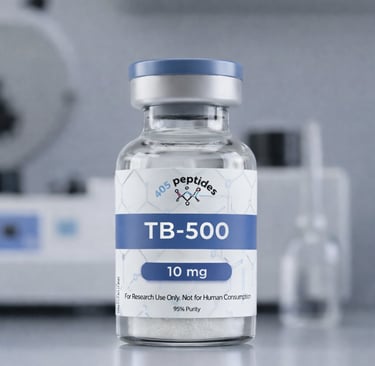
TB-500, derived from thymosin beta-4 and studied for cellular migration signaling
GHK-Cu (it's an ingredient in GLOW), a copper peptide studied for its interaction with gene expression and tissue organization pathways
These peptides are frequently used in laboratory research to examine how molecular signals influence biological systems.
Why Researchers Study Peptides in Regenerative Science
Peptides provide valuable tools for scientists studying complex biological processes. Because peptides are relatively small molecules, researchers can study their structure and signaling interactions in controlled laboratory environments.
Research involving peptides helps scientists explore:
how cells coordinate tissue repair processes
how signaling pathways regulate cellular communication
how molecular signals influence structural proteins
how biological systems maintain tissue integrity
TB-500 10 mg is available for laboratory research through 405 Peptides.
Understanding these molecular systems contributes to broader knowledge in regenerative biology and biotechnology.
Synthetic Peptides in Laboratory Research
Many peptides used in research are produced using synthetic peptide synthesis techniques. These laboratory methods allow scientists to construct precise amino acid sequences and study how these molecules interact with biological systems.
One of the most widely used techniques is solid-phase peptide synthesis, which enables researchers to assemble peptides step by step.
Synthetic peptides are important research tools because they allow scientists to:
isolate specific signaling pathways
investigate receptor binding interactions
study molecular communication networks
analyze biological repair mechanisms
Advances in peptide synthesis technology continue to expand the ability of scientists to investigate complex biological systems.
The Future of Peptide Research in Regenerative Science
Scientific interest in peptide signaling has grown rapidly over the past several decades. As researchers develop more advanced molecular analysis tools, they are able to explore peptide interactions with greater precision.
Peptide research continues to expand across many scientific fields, including:
regenerative biology
tissue engineering
molecular medicine
biotechnology development
Understanding how peptides regulate cellular communication and tissue organization may provide valuable insights into the mechanisms that allow biological systems to maintain and restore structural integrity.
Frequently Asked Questions
What are peptides in regenerative research?
Peptides are small chains of amino acids that act as signaling molecules within biological systems. Researchers study them to better understand how cells communicate and regulate tissue maintenance.
Why do scientists study peptides in tissue repair research?
Scientists study peptides because they influence molecular signaling pathways that regulate cellular communication and structural organization.
What biological processes do regenerative peptides influence?
Research often examines peptide interactions with cellular migration pathways, extracellular matrix regulation, gene expression systems, and molecular communication networks.
How are peptides used in laboratory research?
Peptides used in research are typically produced through synthetic peptide synthesis techniques and studied in controlled laboratory environments.
Research Disclaimer
All compounds available through 405peptides are intended strictly for laboratory and research purposes only and are not intended for human or veterinary use.
Browse our research-grade peptides available at 405Peptides.com.
Contact
Get in touch
Support
© 2025 Copyright. 405peptides. All rights reserved.